
Benign paroxysmal positional vertigo (BPPV): which canal?
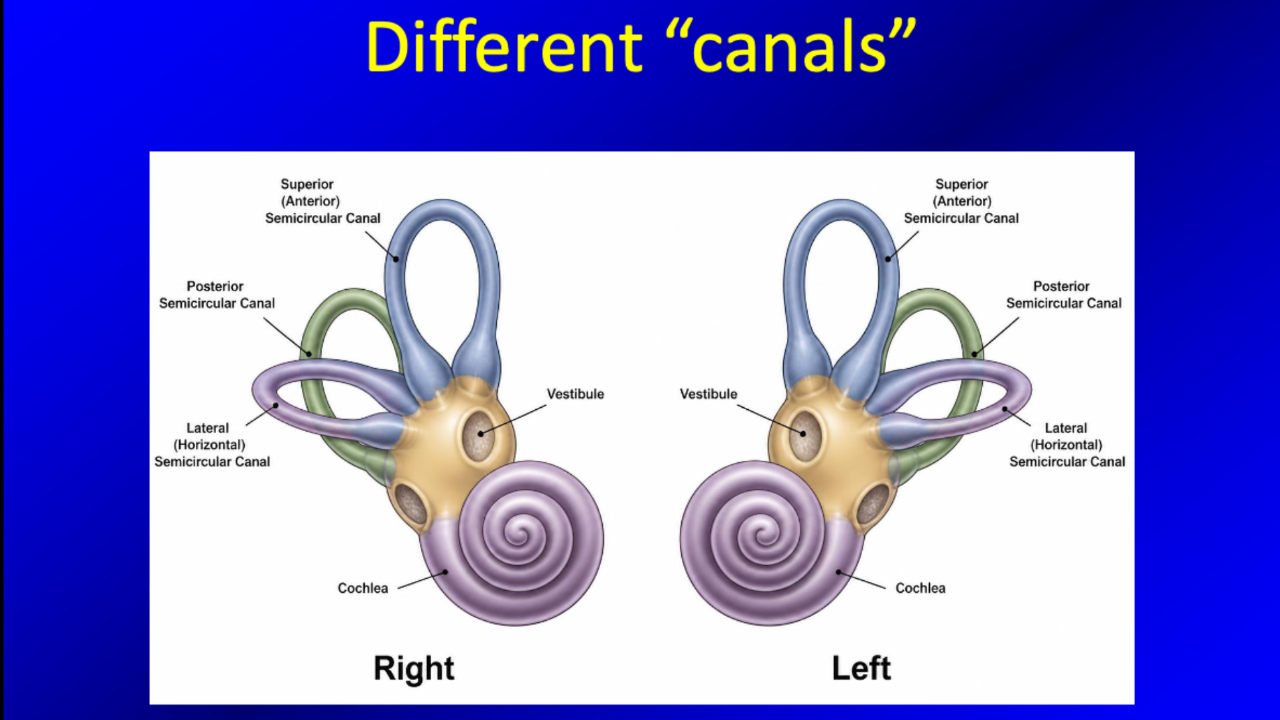
Benign paroxysmal positional vertigo (BPPV) is the most common cause of dizziness and vertigo across all age groups — but did you know there are multiple types, each requiring a different treatment? BPPV occurs when tiny ear crystals called otoliths break loose and enter the semicircular canals of the inner ear. The problem is that the inner ear has three canals — the posterior canal, the lateral canal, and the anterior canal — and each one requires its own specific repositioning maneuver to treat effectively. In fact, more than 25 different maneuvers have been developed to address the various canal combinations that BPPV can affect. Simply guessing which canal is involved and attempting a random maneuver is correct less than half the time — and the wrong maneuver can actually make symptoms worse. The most reliable approach is examining the eye movements that BPPV produces, since these provide the critical clues needed to identify the affected canal and select the right treatment. Whether you're a patient struggling with positional vertigo or a clinician looking to sharpen your diagnostic skills, understanding which canal is involved is the essential first step toward effective treatment.
This material is intended for educational purposes only, and does not substitute evaluation by a qualified medical professional.
In developing this course we reviewed literature (so that you don't have to!)
- Barreto RG, Yacovino DA, Cherchi M, Teixeira LJ, Nader SN, Leão GF (2023) Universal repositioning maneuver: a new treatment for single canal and multi-canal benign paroxysmal positional vertigo by 3-dimensional model analysis. Journal of International Advanced Otology 19: 242-247. doi: 10.5152/iao.2023.22921
- Brandt-Daroff maneuver. Brandt T, Daroff RB (1980) Physical therapy for benign paroxysmal positional vertigo. Arch Otolaryngol 106: 484-5. doi: 10.1001/archotol.1980.00790320036009
- Califano L, Capparuccia PG, Di Maria D, Melillo MG, Villari D (2003) Treatment of benign paroxysmal positional vertigo of posterior semicircular canal by “Quick Liberatory Rotation Manoeuvre”. Acta Otorhinolaryngol Ital 23: 161-7.
- Casani AP, Cerchiai N, Dallan I, Sellari-Franceschini S (2011) Anterior canal lithiasis: diagnosis and treatment. Otolaryngol Head Neck Surg 144: 412-8. doi: 10.1177/0194599810393879
- Chua Wei De K, Gans R, Spinks S (2020) Demographic and clinical characteristics of 1599 BPPV patients. Journal of Otolaryngology-ENT Research 12: 1-11. doi: 10.15406/joentr.2020.12.00451
- Crevits L (2004) Treatment of anterior canal benign paroxysmal positional vertigo by a prolonged forced position procedure. J Neurol Neurosurg Psychiatry 75: 779-81
- Epley JM (1992) The canalith repositioning procedure: for treatment of benign paroxysmal positional vertigo. Otolaryngol Head Neck Surg 107: 399-404. doi: 10.1177/019459989210700310
- Fife TD (2012) Positional dizziness. Continuum (Minneap Minn) 18: 1060-85. doi: 10.1212/01.CON.0000418376.80099.24
- Foster CA, Ponnapan A, Zaccaro K, Strong D (2012) A Comparison of Two Home Exercises for Benign Positional Vertigo: Half Somersault versus Epley Maneuver. Audiology and Neurotology Extra 2: 16-23. doi: 10.1159/000337947
- Gan Z, Zhou S, Yang H, He F, Wei D, Bai Y, Wang Y, Wang Y, Fu W, Han J (2021) Self-Treatment of Posterior Canal Benign Paroxysmal Positional Vertigo: A Preliminary Study. Front Med (Lausanne) 8: 654637. doi: 10.3389/fmed.2021.654637
- Gans RE, Kurtzer D, McLeod H (2017) New Horizontal Canal Benign Paroxysmal Positional Vertigo Treatment: Kurtzer Hybrid Maneuver. Global Journal of Otolaryngology 6: 44-48. doi: 10.19080/GJO.2017.06.555686
- Garaycochea O, Perez-Fernandez N, Manrique-Huarte R (2022) A novel maneuver for diagnosis and treatment of torsional-vertical down beating positioning nystagmus: anterior canal and apogeotropic posterior canal BPPV. Braz J Otorhinolaryngol 88: 708-716. doi: 10.1016/j.bjorl.2020.09.009
- Gufoni M, Mastrosimone L, Di Nasso F (1998) [Repositioning maneuver in benign paroxysmal vertigo of horizontal semicircular canal]. Acta Otorhinolaryngol Ital 18: 363-7
- Kim JS, Zee DS (2014) Clinical practice. Benign paroxysmal positional vertigo. N Engl J Med 370: 1138-47. doi: 10.1056/NEJMcp1309481
- Kim YK, Shin JE, Chung JW (2005) The effect of canalith repositioning for anterior semicircular canal canalithiasis. ORL J Otorhinolaryngol Relat Spec 67: 56-60. doi: 10.1159/000084336
- Korres S, Riga M, Sandris V, Danielides V, Sismanis A (2010) Canalithiasis of the anterior semicircular canal (ASC): treatment options based on the possible underlying pathogenetic mechanisms. Int J Audiol 49: 606-12. doi: 10.3109/14992021003753490
- Lee DH, Park JY, Kim TH, Shin JE, Kim CH (2022) New Therapeutic Maneuver for Horizontal Semicircular Canal Cupulolithiasis: A Prospective Randomized Trial. J Clin Med 11. doi: 10.3390/jcm11144136
- Lempert T, Tiel-Wilck K (1996) A positional maneuver for treatment of horizontal-canal benign positional vertigo. Laryngoscope 106: 476-8. doi: 10.1097/00005537-199604000-00015
- Li J, Li H (2010) New repositioning techniques for benign paroxysmal positional vertigo: the Li repositioning manoeuvres. J Laryngol Otol 124: 905-8. doi: 10.1017/S0022215109992520
- Nedzelski JM, Barber HO, McIlmoyl L (1986) Diagnoses in a dizziness unit. J Otolaryngol 15: 101-4.
- Neuhauser HK (2007) Epidemiology of vertigo. Curr Opin Neurol 20: 40-6. doi: 10.1097/WCO.0b013e328013f432
- Parnes LS, Agrawal SK, Atlas J (2003) Diagnosis and management of benign paroxysmal positional vertigo (BPPV). CMAJ 169: 681-93.
- Rahko T (2002) The test and treatment methods of benign paroxysmal positional vertigo and an addition to the management of vertigo due to the superior vestibular canal (BPPV-SC). Clin Otolaryngol Allied Sci 27: 392-5. doi: 10.1046/j.1365-2273.2002.00602.x
- Ramos BF, Cal R, Brock CM, Mangabeira Albernaz PL, Zuma EMF (2021) Zuma Modified Maneuver as a Treatment to Geotropic Lateral Semicircular Canal Benign Paroxysmal Positional Vertigo. Int Arch Otorhinolaryngol 25: e255-e257. doi: 10.1055/s-0040-1712935
- Roberts RA, Gans RE, Montaudo RL (2006) Efficacy of a new treatment maneuver for posterior canal benign paroxysmal positional vertigo. J Am Acad Audiol 17: 598-604. doi: 10.3766/jaaa.17.8.6
- Semont A, Freyss G, Vitte E (1988) Curing the BPPV with a liberatory maneuver. Adv Otorhinolaryngol 42: 290-3. doi: 10.1159/000416126
- Shim DB, Song CE, Jung EJ, Ko KM, Park JW, Song MH (2014) Benign paroxysmal positional vertigo with simultaneous involvement of multiple semicircular canals. Korean J Audiol 18: 126-30. doi: 10.7874/kja.2014.18.3.126
- Strupp M, Goldschagg N, Vinck AS, Bayer O, Vandenbroeck S, Salerni L, Hennig A, Obrist D, Mandala M (2021) BPPV: Comparison of the SemontPLUS With the Semont Maneuver: A Prospective Randomized Trial. Front Neurol 12: 652573. doi: 10.3389/fneur.2021.652573
- Vannucchi P, Libonati G, Gufoni M, Asprella Libonati G (2005) The Physical Treatment of Lateral Semicircular Canal Canalolithiasis. Audiological Medicine 3: 52-56. doi: 10.1080/16513860510029445
- von Brevern M, Radtke A, Lezius F, Feldmann M, Ziese T, Lempert T, Neuhauser H (2007) Epidemiology of benign paroxysmal positional vertigo: a population based study. J Neurol Neurosurg Psychiatry 78: 710-5. doi: 10.1136/jnnp.2006.100420.
- Yacovino DA, Hain TC, Gualtieri F (2009) New therapeutic maneuver for anterior canal benign paroxysmal positional vertigo. J Neurol 256: 1851-5. doi: 10.1007/s00415-009-5208-1
- Zuma e Maia F (2016) New Treatment Strategy for Apogeotropic Horizontal Canal Benign Paroxysmal Positional Vertigo. Audiol Res 6: 163. doi: 10.4081/audiores.2016.163