
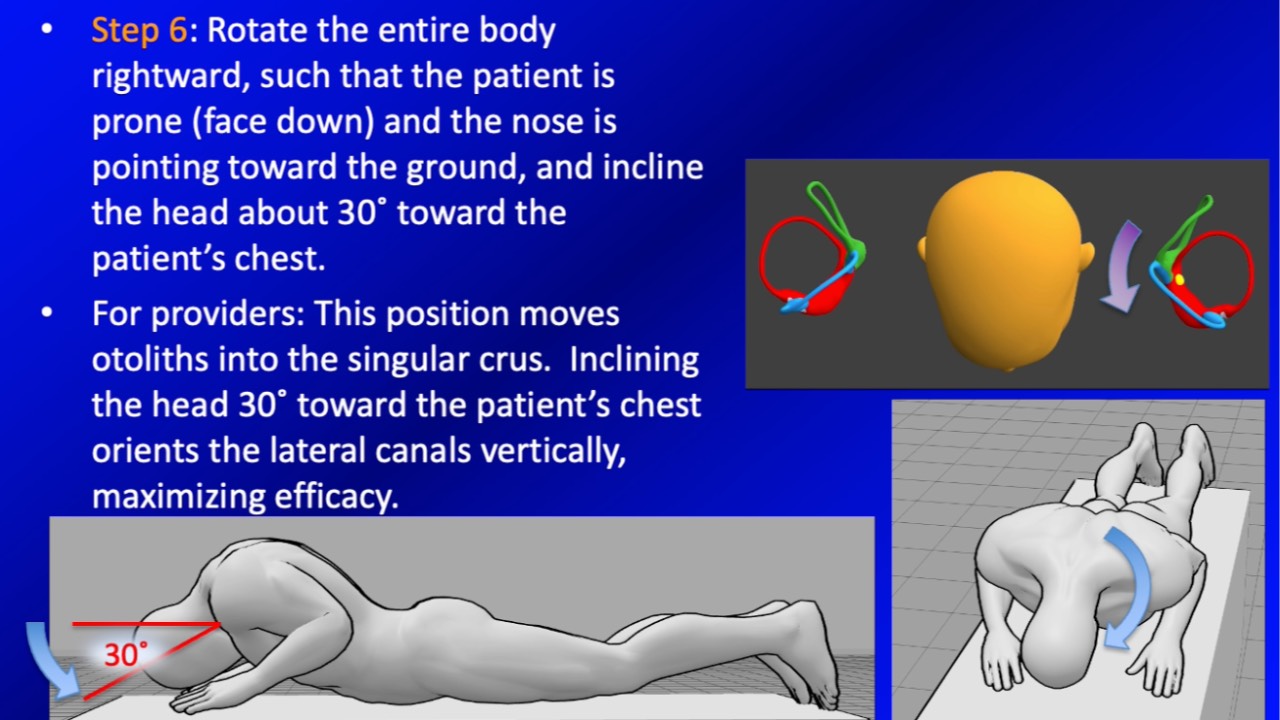
Diagnose BPPV of the lateral canal, and treat it with the Lempert roll
Most BPPV resources focus on the posterior canal — because it's the most common. But lateral canal BPPV is the second most frequent variant, and it requires an entirely different diagnostic and treatment approach. Very few resources show you what the diagnostic eye movements actually look like, or explain why the Lempert roll works when it does. In this course, we do all three: we explain the mechanical basis of lateral canal BPPV so you understand what's happening in the inner ear, display and explain the diagnostic eye movements that distinguish lateral canal involvement from other BPPV variants, and teach the Lempert roll for treatment of both right- and left-sided disease. Getting the diagnosis right before starting treatment isn't just good practice — it's the difference between a maneuver that works and one that doesn't.
This material is intended for educational purposes only, and does not substitute evaluation by a qualified medical professional.
In developing this course we reviewed literature (so that you don't have to!)
This maneuver was originally described in this article:
- Lempert T, Tiel-Wilck K (1996) A positional maneuver for treatment of horizontal-canal benign positional vertigo. Laryngoscope 106: 476-8. doi: 10.1097/00005537-199604000-00015
Literature that may be useful for patients:
- Bastani P, Phillips V, Rieiro H, Otero-Millan J, Zee D, Newman-Toker D, Tehrani A (2025) Feasibility of Using Smartphone Eye-Tracking for Self-recording Positional Tests. Digital Biomarkers: 1-11. doi: 10.1159/000545720
- Bhandari R, Bhandari A, Hsieh Y-H, Edlow J, Omron R (2023) Prevalence of Horizontal Canal Variant in 3,975 Patients With Benign Paroxysmal Positional Vertigo: A Cross-sectional Study. Neurology: Clinical Practice 13: e200191. doi: 10.1212/CPJ.0000000000200191
- Casani AP, Nacci A, Dallan I, Panicucci E, Gufoni M, Sellari-Franceschini S (2011) Horizontal semicircular canal benign paroxysmal positional vertigo: effectiveness of two different methods of treatment. Audiol Neurootol 16: 175-84. doi: 10.1159/000317113
- Melliti A, van de Berg M, van de Berg R (2023) Capturing nystagmus during vertigo attacks using a smartphone: adherence, characteristics, pearls and pitfalls. J Neurol. doi: 10.1007/s00415-023-11965-y
- Phillips V, Bastani PB, Rieiro H, Hale DE, Otero-Millan J, Zee DS, Newman-Toker DE, Tehrani AS (2025) A Pilot Study of Smartphone Eye Tracking for Detection of Positional Nystagmus. Digit Biomark 9: 124-129. doi: 10.1159/000547008
Literature for specialists who want to dig deeper:
- Balatsouras DG, Koukoutsis G, Ganelis P, Economou NC, Moukos A, Aspris A, Katotomichelakis M (2014) Benign paroxysmal positional vertigo secondary to vestibular neuritis. Eur Arch Otorhinolaryngol 271: 919-24. doi: 10.1007/s00405-013-2484-2
- Baloh RW, Honrubia V, Jacobson K (1987) Benign positional vertigo: clinical and oculographic features in 240 cases. Neurology 37: 371-8. doi: 10.1212/wnl.37.3.371
- Correia F, Castelhano L, Cavilhas P, Escada P (2022) Lateral semicircular canal-BPPV: Prospective randomized study on the efficacy of four repositioning maneuvers. Acta Otorrinolaringol Esp (Engl Ed) 73: 27-34. doi: 10.1016/j.otoeng.2020.11.002
- Fife TD (2012) Positional dizziness. Continuum (Minneap Minn) 18: 1060-85. doi: 10.1212/01.CON.0000418376.80099.24
- Kim JS, Oh SY, Lee SH, Kang JH, Kim DU, Jeong SH, Choi KD, Moon IS, Kim BK, Kim HJ (2012) Randomized clinical trial for geotropic horizontal canal benign paroxysmal positional vertigo. Neurology 79: 700-7. doi: 10.1212/WNL.0b013e3182648b8b
- Kutlubaev MA, Xu Y, Hornibrook J (2019) Benign paroxysmal positional vertigo in Meniere’s disease: systematic review and meta-analysis of frequency and clinical characteristics. J Neurol. doi: 10.1007/s00415-019-09502-x
- Riggio F, Dispenza F, Gallina S, Kulamarva G, Gargano R, Speciale R (2009) Management of benign paroxysmal positional vertigo of lateral semicircular canal by Gufoni's manoeuvre. Am J Otolaryngol 30: 106-11. doi: 10.1016/j.amjoto.2008.03.001
- Shah MU, Lotterman S, Roberts D, Eisen M (2019) Smartphone telemedical emergency department consults for screening of nonacute dizziness. Laryngoscope 129: 466-469. doi: 10.1002/lary.27424
- Teixido M, Woods O, Kung B, Seyyedi M (2016) A 3D benign paroxysmal positional vertigo model for study of otolith disease. World J Otorhinolaryngol Head Neck Surg 2: 1-6. doi: https://doi.org/10.1016/j.wjorl.2016.02.002
- Traboulsi H, Teixido M (2021) BPPV Viewer: A downloadable 3D BPPV model for study of otolith disease. World Journal of Otorhinolaryngology - Head and Neck Surgery 7: 34-39. doi: 10.1016/j.wjorl.2018.10.001
- von Brevern M, Radtke A, Lezius F, Feldmann M, Ziese T, Lempert T, Neuhauser H (2007) Epidemiology of benign paroxysmal positional vertigo: a population based study. J Neurol Neurosurg Psychiatry 78: 710-5. doi: 10.1136/jnnp.2006.100420